















 2026-01-05
As artificial intelligence, cloud computing, and high-performance computing continue to advance, data centers are rapidly transitioning toward high-density computing architectures. Rack-level power density keeps rising, while system availability and operational continuity become increasingly critical.
Under these conditions, safety expectations for power backup systems are fundamentally changing. In AIDC and AI data center environments, a UPS lithium battery is required not only to provide backup power, but also to operate safely and predictably under sustained high electrical and thermal stress. This article explains how UPS lithium batteries meet the safety requirements of high-density computing through layered design and system-level coordination.
Why High-Density Computing Redefines UPS Battery Safety
Traditional data center power environments were characterized by moderate power density and relatively stable load profiles. High-density computing changes this equation.
With AI training, large-scale inference, and high-performance workloads, power demand can surge within milliseconds. Heat generation becomes concentrated, and operating margins narrow. As a result, UPS battery safety is no longer a static requirement, but a dynamic capability that must function under extreme and rapidly changing conditions.
In this context, safety must be redefined as the ability to remain controlled, stable, and predictable—even when operating close to system limits.
What Safety Requirements High-Density Computing Imposes on UPS Systems
High-density computing environments impose several concrete safety requirements on UPS systems:
● High-power discharge capability during sudden load changes
● Thermal stability in compact and enclosed spaces
● Continuous monitoring to detect abnormal conditions early
● Effective fault isolation to prevent risk propagation
A high-density computing UPS battery must therefore be designed not only for performance, but also for continuous risk management across its entire operating lifecycle.
The Role of UPS Lithium Batteries in AIDC Power Architectures
In AIDC power architectures, the UPS system represents the final line of defense between grid instability and mission-critical computing loads. A UPS battery for AIDC must respond within milliseconds, maintain voltage stability during high-power discharge, and integrate seamlessly into complex power infrastructures.
UPS lithium batteries are widely adopted in these scenarios because they are well suited to high-performance backup requirements. More importantly, modern UPS lithium battery solutions are developed around safety-oriented system architectures, aligning performance capability with strict risk control requirements in high-density computing environments.
Safety Starts at the Cell Level: Building a Stable Foundation
Safety performance begins at the most fundamental level: the battery cell.
In a UPS lithium battery system, cell-level characteristics directly influence thermal behavior, electrical stability, and long-term reliability. Key design considerations include:
● Battery chemistry selected for thermal stability
● Tight control of manufacturing consistency to reduce imbalance
● Optimized internal resistance to limit excess heat generation
By establishing a stable and predictable cell foundation, system-level safety becomes more manageable. This cell-level discipline sets the upper boundary for operational risk and supports consistent behavior under high load conditions.
Multi-Layer Protection for Module-Level Safety and Thermal Runaway Prevention
One of the most critical safety objectives in high-density computing is thermal runaway prevention. No single protective measure is sufficient; effective risk control requires multi-layer protection.
1. Battery Management Systems Enable Real-Time Risk Control
An advanced Battery Management System (BMS) continuously monitors voltage, temperature, current, and operating status at cell and module levels. Real-time data allows the system to detect early warning signals and initiate controlled responses before conditions escalate.
2. Thermal Management Maintains Safe Operating Conditions
Module-level thermal management design plays a decisive role in maintaining safe operating temperatures. Structured airflow, temperature zoning, and heat-resistant materials help ensure thermal stability across the battery system, even during sustained high-power discharge.
3. Electrical and Structural Isolation Limits Risk Propagation
Electrical isolation and structural segmentation prevent localized issues from spreading across the system. This containment capability is particularly important for UPS lithium battery safety in dense installations where multiple systems operate in close proximity.
System-Level Safety Enables Reliable Operation Under Extreme Load
Safety in AIDC environments cannot rely on individual components alone. A UPS lithium battery system must operate safely as part of an integrated power architecture.
System-level safety design addresses:
● Seamless switching during power disturbances
● Stable output during prolonged high-load operation
● Coordinated protection logic across multiple subsystems
This system-wide coordination ensures that safety is preserved not only during normal operation, but also under fault and stress conditions typical of high-density computing.
Putting Cell–Module–System Safety into Practice: Vision Battery UPS Lithium Solutions
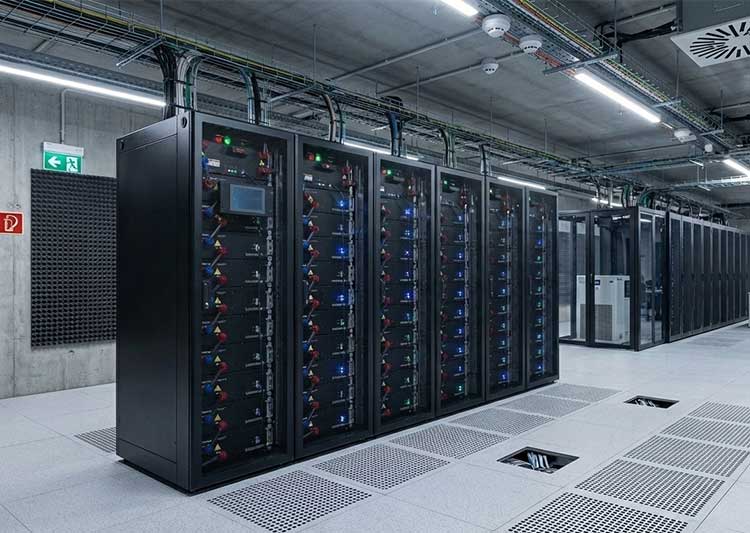
The safety principles described above are realized in the Vision Battery REVO 3.0 UPS lithium battery system, which adopts a series-first, parallel-second architecture and implements a four-level safety framework: cell, module, rack, and system.
1. Cell-Level Safety
REVO 3.0 uses high-stability lithium iron phosphate (LFP) chemistry for excellent thermal performance.
Key features: prismatic aluminum housing, built-in CID safety valve, and stable electrochemical behavior—forming a reliable foundation for the battery system.
2. Module-Level Safety
Modules are designed for precise control and thermal stability: laser-welded connections, high-precision BMU for cell balancing and temperature management, and active cooling with airflow channels. This ensures even temperature distribution and reduces thermal stress during high-load operation.
3. Rack-Level Safety
At the cabinet level, REVO 3.0 integrates multi-layer protection: high-precision BMS, vibration-resistant design, and early fire detection with efficient suppression. This prevents localized issues from affecting the entire system.
4. System-Level Safety
The system incorporates main-circuit fuses, full electrical isolation, and coordinated protection logic. These measures ensure controlled operation and contain risks even under extreme conditions.
Conclusion
High-density computing fundamentally reshapes the safety requirements placed on power backup systems. In AIDC and AI data center environments, UPS lithium battery safety is defined by controlled behavior under high load, effective thermal runaway prevention, and coordinated system-level protection.
By integrating cell-level stability, module-level multi-layer protection mechanisms, and system-wide safety coordination, modern UPS lithium batteries are well positioned to meet the demands of high-density computing.
 Name
Name Tel
Tel Email
Email Country
 Company
 Information