













 2026-02-02
As AI computing workloads continue to grow in scale and complexity, power systems in AIDC (AI Data / Computing Centers) face unprecedented demands. Among them, the ability of the UPS battery to support high-rate discharge has become a critical factor for system safety and reliability. Compared with traditional data centers, AI computing environments expose UPS batteries to more frequent, faster, and higher-current discharge events, creating new technical and safety challenges.
What Is High-Rate Discharge in AI Computing
High-rate discharge refers to the ability of a battery to deliver a large amount of current within a very short time. In AI computing scenarios, rapid load ramp-up occurs when GPU clusters, AI accelerators, or large-scale inference tasks start or change operating states.
When grid power fluctuates or fails, the UPS lithium battery must instantly take over the full load. In high-density AIDC environments, this often means discharging at a much higher rate than in conventional data centers, placing significant stress on battery cells and the overall UPS system.
Why AI Computing Increases High-Rate Discharge Demands
1. Rapid and Frequent Load Fluctuations
AI workloads are highly dynamic. Training and inference tasks can start, stop, or scale rapidly, causing sudden changes in power demand. UPS batteries must respond immediately, repeatedly switching between float charge and high-rate discharge modes.
2. Ultra-High Power Density
Modern AI racks concentrate massive computing power in a limited space. As a result, a single UPS system may be required to support extremely high instantaneous power output, pushing the discharge capability of the battery close to its design limits.
3. Minimal Tolerance for Power Interruption
AI computing systems are highly sensitive to voltage drops and transfer delays. Even millisecond-level instability can disrupt training jobs or real-time inference services, leaving little margin for slow or unstable battery response.
Key Challenges of High-Rate Discharge for UPS Batteries
1. Increased Thermal Stress
High discharge currents generate significant internal heat. In high-density AIDC environments, limited cooling space makes heat dissipation more difficult, increasing the risk of overheating and thermal runaway.
2. Accelerated Battery Aging
Repeated high-rate discharge accelerates internal degradation of battery cells, increases internal resistance, and shortens the overall lifespan of the UPS battery, especially under long-term float operation.
3. Voltage Stability and System Protection
During high-rate discharge, maintaining stable output voltage is critical. Insufficient protection or slow response can lead to voltage sag, triggering system alarms or even IT load shutdown.
4. Reduced Safety Margin
When batteries operate close to their maximum discharge capability, the available safety margin is reduced. Any abnormal condition—such as cell imbalance or local overheating—can quickly escalate into a system-level risk.
Strategies to Address High-Rate Discharge Challenges
1. Selecting Intrinsically Stable Battery Chemistry
Lithium iron phosphate (LFP) batteries offer better thermal stability and high-rate discharge capability, making them more suitable for AI computing UPS applications.
2. Advanced Thermal Management Design
Optimized airflow, cabinet-level cooling, and real-time temperature monitoring help control heat generation during high-current discharge and prevent local hot spots.
3. Intelligent Battery Management System (BMS)
A high-performance BMS enables real-time monitoring of voltage, current, and temperature at cell and module level, ensuring fast protection response and safe operation during extreme discharge events.
4. System-Level and Full-Link Safety Protection
From cell design and module structure to cabinet integration and system-level protection, a full-link safety strategy ensures that high-rate discharge risks are managed throughout the entire UPS lithium battery life cycle.
Vision Battery‘s UPS Battery Solution for AI Computing
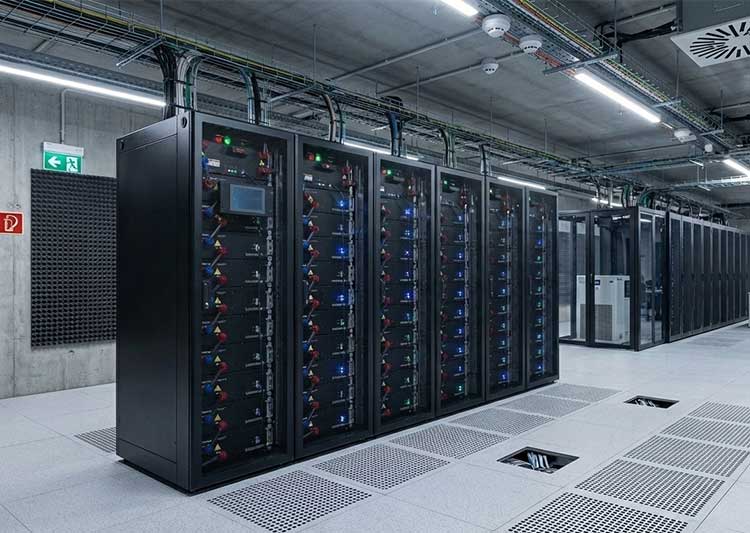
To address safety challenges in high-density and high-dynamic AIDC environments, Vision Battery’s REVO 3.0 UPS lithium battery solution combines advanced cell technology with system-level intelligent protection.
It features a 4L (Cell–Module–Cabinet–System) hierarchical safety architecture, delivering full-link protection across the entire UPS power chain.
REVO 3.0 adopts Vision Battery’s self-developed high-safety lithium iron phosphate (LFP) cells, optimized for high-rate discharge, frequent load fluctuations, and long-term reliability in AI computing scenarios.
A real-time monitoring BMS continuously tracks critical operating parameters, enabling early risk detection and fast protective response.
Together, the 4L safety architecture, high-safety LFP cells, and intelligent BMS ensure stable, safe, and reliable power support for AI data centers under extreme operating conditions.
Conclusion
High-rate discharge capability is no longer a secondary consideration for UPS batteries in AI computing—it is a core requirement. Ultra-high power density, dynamic workloads, and strict reliability expectations place UPS lithium batteries under continuous high-stress operation.
To support safe and uninterrupted AI computing, AIDC operators must adopt UPS battery systems designed specifically for high-rate discharge, featuring stable battery chemistry, advanced thermal management, intelligent monitoring, and full-link safety protection. Only with these measures in place can UPS batteries meet the demanding power requirements of modern AI computing environments.
 Name
Name Tel
Tel Email
Email Country
 Company
 Information