













 2026-09-11
Vision Group’s REVO3.0 AIDC LFP Battery Backup Power System has successfully completed the world’s first indoor Large-Scale Fire Test (LSFT) conducted in strict accordance with the latest UL 9540A-2026, 6th Edition.
After 74 minutes of full thermal runaway and combustion, thermal runaway remained fully contained within the initiating module, with zero propagation to adjacent cabinets. All three core criteria were successfully passed. The test was witnessed throughout by JENSEN HUGHES and UL Solutions, with traceable and verifiable test data.

Real Data Center Conditions. Extreme Test Conditions.
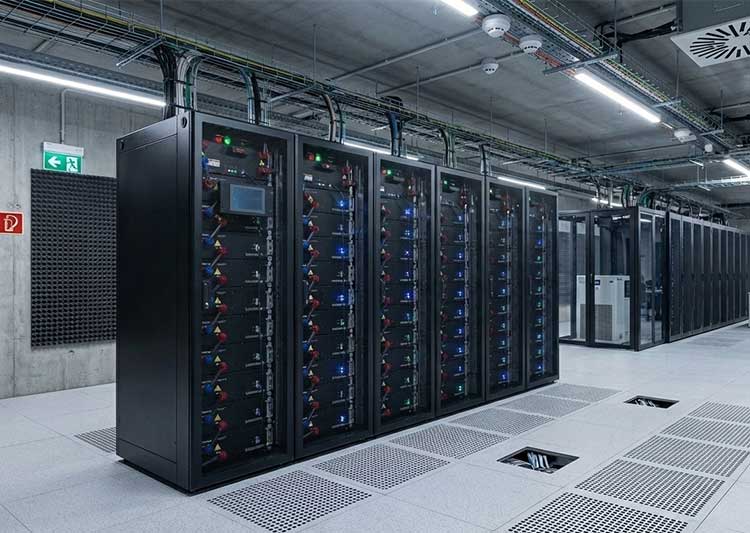
Designed for high-density backup power applications in AI data centers, the test used the 600kW REVO3.0 AIDC LFP Battery Backup Power System.
The test environment fully reproduced data center conditions, including walls, ceiling structures and ventilation. All three cabinets were fully charged at 100% SOC. The initiating cabinet was positioned 0 cm from Target Cabinet A and 68 cm from Target Cabinet B, creating an extremely compact deployment scenario while meeting all mandatory UL 9540A-2026 LSFT prerequisites.
All active fire suppression and thermal runaway intervention systems were disabled, leaving only the cabinet’s passive fire protection. With cabinet doors fully open, the system was exposed to oxygen and subjected to the standard-defined worst-case scenario, followed by open-door flame exposure and 120 minutes of continuous water spray.
Test Results: Thermal Runaway Fully Contained
- The initiating Module 7 underwent 74 minutes of full thermal runaway combustion, with no explosion.
- Adjacent Modules 6 and 8 experienced no thermal propagation or thermal runaway and remained fully charged after testing.
- Target Cabinets A (0 cm) and B (68 cm) remained intact, with no thermal propagation or significant fire damage.
- System voltage decreased from 640V to 580V, while normal voltage output was maintained.
- Following 120 minutes of water spray and 24 hours of observation, there was no re-ignition, leakage or high-voltage arcing. All three cabinets remained operational.
- The initiating cabinet showed visible fire damage, but no collapse or significant structural deformation.
Against the three core UL 9540A-2026 criteria—fire propagation to adjacent cabinets, building structure temperature rise, and fire barrier integrity—the test achieved a full pass.

From Compliance to System-Level Safety Validation
Unlike conventional outdoor or unit-level testing, this full-scale indoor test provides direct engineering value for data center deployment.
The test advances lithium battery safety validation from cell- and equipment-level verification to system-level validation across modules, cabinets and fire protection systems.
For data center design, the 0 cm zero-propagation result provides practical reference data for fire separation, pressure relief and fire protection design.
For compliance and approval, the test data supports NFPA 855-related requirements, PE engineering sign-off and on-site compliance approval for the 600kW REVO3.0 system.
For the AI era, the test establishes a new practical benchmark for indoor large-scale fire safety validation of data center backup power systems.

Vision Group: Safety Must Be Proven in Real-World Conditions
A Vision Group representative said:
“As data center power density continues to rise, backup power safety must be validated under real deployment conditions. This test was not simply a marketing event—it used real-world test data to address critical engineering challenges. We hope these results can serve as a practical reference for PE engineers, data center owners and design institutes.”
A New Benchmark for High-Reliability AIDC Backup Power
The transition from standards-based requirements to full-scale real-world validation marks an important step in the evolution of indoor data center backup power safety.
With 74 minutes of extreme combustion, zero fire propagation at 0 cm spacing, and continued system operability after water spray, REVO3.0 demonstrates that system-level safety can withstand worst-case conditions—not simply remain on paper.
As AI computing drives higher power density and continuity requirements, backup power has become a critical part of continuous computing operations. System-level safety—from cells and modules to cabinets and fire protection—is the foundation of high-reliability AIDC backup power.
 Name
Name Tel
Tel Email
Email Country
 Company
 Information